
What Is Net Promoter Score

What is Net Promoter Score

- What is Net Promoter Score
- Definition of Net Promoter Score (NPS)
- How to Calculate your NPS?
- Net Promoter Score Vs. Customer Satisfaction Scor (CSAT) Survey
- Why is Net Promoter Score important
- How to Improve your Net Promoter Score?
- When’s the right time to measure NPS?
- Benefits of an NPS program
- Net Promoter Score: Best Practices
- Choosing an NPS Platform
- Key Features of NPS Platform
- Role of Net Promoter Score in Industries
- Getting Started with NPS Platform
- Net Promoter Score FAQs
Definition of Net Promoter Score (NPS)
Net Promoter Score is defined as, “A customer loyalty metric that analyzes customer sentiments in order to understand their inclination towards recommending a company to a friend or colleague.”
A high NPS is indicative of the strong connection a customer has towards a brand. It goes without a say that Customer Relationship is the key to the success of any business. In an ideal scenario, the percentage of returning customers would give you a clear picture of their loyalty towards your brand or company.
To elaborate a little, Promoters are the folks who are loyal to the brand and who do not have second thoughts about recommending it to a friend or family. On the other hand, Passives are the customers who are neither happy nor unhappy with the product; they remain neutral and can easily switch brands. Detractors are bad news. They are thoroughly displeased group of people who can easily bring down a brand with their word-of-mouth criticisms. Many brands have tumbled down their pedestal with detractors posting a negative review, tweet, or post, online.
How to Calculate your NPS?
PNPS calculation is pretty straightforward. Follow these steps to calculate the Net Promoter Score for your business.

Suppose you have 70 promoters, 30 detractors, and 0 passives. Your promoter percentage is 70, detractor percentage is 30, and your overall NPS is 70-30=40. Let’s see what happens when you have 50 passives as well. The total= 70+30+50= 150. Your promoter percentage is 46.6% while the detractor percentage is 20%. The NPS is 26. Do you see the change? The NPS has dipped significantly in the latter case. Therefore, you must give much attention to the passives & detractors and ideally, convert as many as possible into your promoters pool.
Net Promoter Score Vs. Customer Satisfaction Score (CSAT) Survey
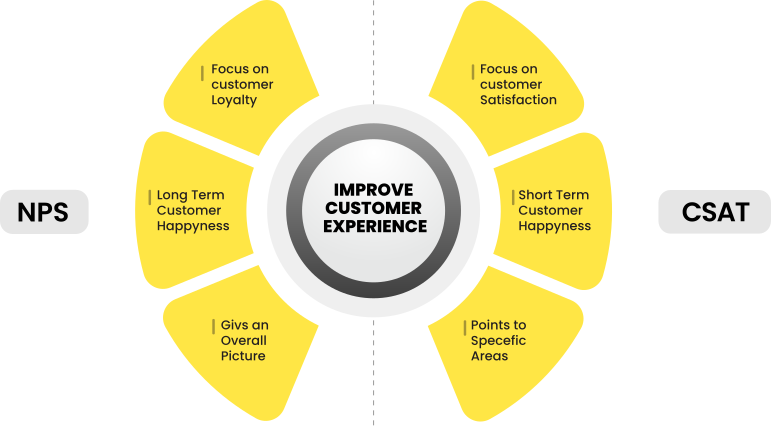
CSAT score is a popular tool used for measuring customer satisfaction. CSAT surveys are sent to the customers after they interact with a brand, for instance, after a support query. These surveys are capable of measuring how satisfied customers are with a product or services a company offers. A high CSAT score indicates a higher level of satisfaction. However, being satisfied doesn’t necessarily guarantee if the customer will make recurring purchases in the future. Therefore, what’s the best way to know this? By using the net promoter score, of course!
Net Promoter Score uncovers the likelihood of a customer recommending the brand to a friend or family. Consequently, it throws light on how loyal the customer is and the probability of a long-term relationship. How are the two different? NPS measures long-term customer happiness while CSAT focusses on short-term happiness. The Net Promoter Score measures the loyalty a customer has towards a brand while CSAT measures the level of satisfaction. NPS helps to predict the likelihood of customers making recurring purchases, while CSAT gives insights into customer satisfaction alone
Why is Net Promoter Score important
The net promoter score is a customer loyalty index whose value ranges from -100 to +100. If your company has an NPS value that lies above 0, it is deemed as a good score. An NPS of 50 and above is great, while a score above 70 is top-notch. However, a score below 0 is bad news. It means that you have fewer promoters in your customer pool. Let’s dig a little deeper. What can a business infer from the net promoter score? A higher Net Promoter Score indicates that you have more promoters as customers while a poor score points towards a pool of passives or detractors. Therefore, it is always essential to have a high net promoter score. More promoters mean, more happy, loyal customers. Loyal customers help to bring in new customers with positive word-of-mouth and referrals. As a result, the revenue and growth of the company increase notably. In addition, the cost of acquiring new customers is significantly reduced. Loyal customers do more than what even your most ingenious advertising strategies can do. Therefore, it is essential to monitor your Net Promoter Score continually and take the right steps to improve it constantly.
To put things straight, the Net Promoter Score can help you understand how loyal your customers are, what are the reasons behind customer churn, and take the necessary steps to enhance customer experience.

Collect feedback, analyze data, compute NPS, and improve continually.
How to Improve your Net Promoter Score?
Improving your net promoter score is a continuous process that requires diligent planning and execution. Since NPS comes with many positives, it is vital to get things right. For this very purpose, we bring you six NPS strategies that can turn the table for your business in no time.

Powerful brand promotion

Focus on Detractors & Passives

Don’t forget the Promoters

Reduce Average Resolution Time

Involve all teams

Monitor your NPS continually
When’s the right time to measure NPS?
Relationship NPS Surveys
Relationship NPS surveys seek to uncover the overall loyalty a customer has towards a brand. Also known as on-demand surveys, it is designed to calibrate customer relationships and customer engagement. In this case, the overall experience and satisfaction are considered. Relationship NPS surveys are conducted at regular intervals, for instance, once in a quarter, and they help to spot the gaps in the customer experience journey.
Transactional NPS Surveys
Transactional NPS surveys bring out the customer experience at a particular touch-point. Contrary to relationship surveys, transactional surveys indicate the satisfaction associated with a particular event- sales interaction, product quality, support assistance, etc. Thus, these are administered immediately after the interaction. Transactional NPS surveys are designed with the intent of measuring customer loyalty associated with a specific touch-point.
NOTE: Be it transactional or relationship NPS surveys, ensure you don’t reach out to the same customer more than once, within a defined time period. This can avoid the effect of spamming and help you get untampered data.
Benefits of an NPS program
Give Better Customer Experience
With the help of an NPS survey, you can understand what your customers think of your product or service. You can go one more step and find out why they gave a particular rating. This will help you understand the gap between what you provide and what customers expect. Maybe they didn’t like a feature, or the support was poor- find out and rectify it, right away.
Maintain Great Customer Relationships
Use NPS to know which of your customers require more attention and cajoling- naturally, the detractors & passives. You can interact with your promoters periodically to ensure they are happy. However, you may need to go an extra step to turn the frowns of passives & detractors upside down. For instance, you can give special discounts or coupons to engage with them better.
Get the Big Picture
While customer health metrics like CES & CSAT focus on the customer’s most recent interaction with a product, NPS helps you ascertain the big picture. As a result, you can gather an idea about the customer experience journey a client has with you, rather than isolated touch-points.
Assess Business Health
A poor net promoter score indicates that your business is not coursing in the right direction. A pool of grumpy customers is not something a company must have, at any point of its lifecycle. Therefore, keep collecting NPS data to find out where your business must improve, and make the required amends without delay. This will help to improve the overall customer experience and NPS.
Net Promoter Score: Best Practices
#1: Follow-up
Golden rule #1 while implementing NPS lies in what you do after calculating the score and analyzing the NPS data. And this must be, without doubt, following-up with customers and building stronger client relationships. Always reach out to your customers after they submit the NPS survey, thank them for their time & valuable inputs, and assure them steps are in order based on their feedback.
#2: Pick the right time
Don’t bombard your customers with NPS surveys and that too at the wrong time. Plan it over the entire year and send out NPS surveys once every quarter. This is the case for relationship NPS surveys. In the case of transactional NPS surveys, the right time to share the survey is shortly after purchase or interaction. Consequently, you can build a routine feedback loop to know how your company is performing.
#3: Monitor the Progress
Don’t stop your NPS journey after the first time. How your net promoter score fares with time is just as important as the score itself. A plummeting NPS is an indication that your strategies need rethinking and reworking. Therefore, you can understand if your business is coursing in the right direction by tracking your NPS with time. Also, it goes without saying that your NPS graph must always have an upward trend.
#4: Perform Segmented Analysis
While you analyze the NPS data, make sure you do it right. Very often, companies have volumes of data but aren’t able to use it well. Therefore, filter your responses based on specific parameters to understand the top reasons why customers like/dislike your brand. Consequently, you can even develop a new feature to address and remove the major customer pain-points.
Choosing an NPS Platform

Capture Feedback Efficiently

Dig Deep into the Data

Follow-up and Engage
Key Features of NPS Platform
In this section, we’ll walk you through the key features any great NPS platform should offer to its clients.
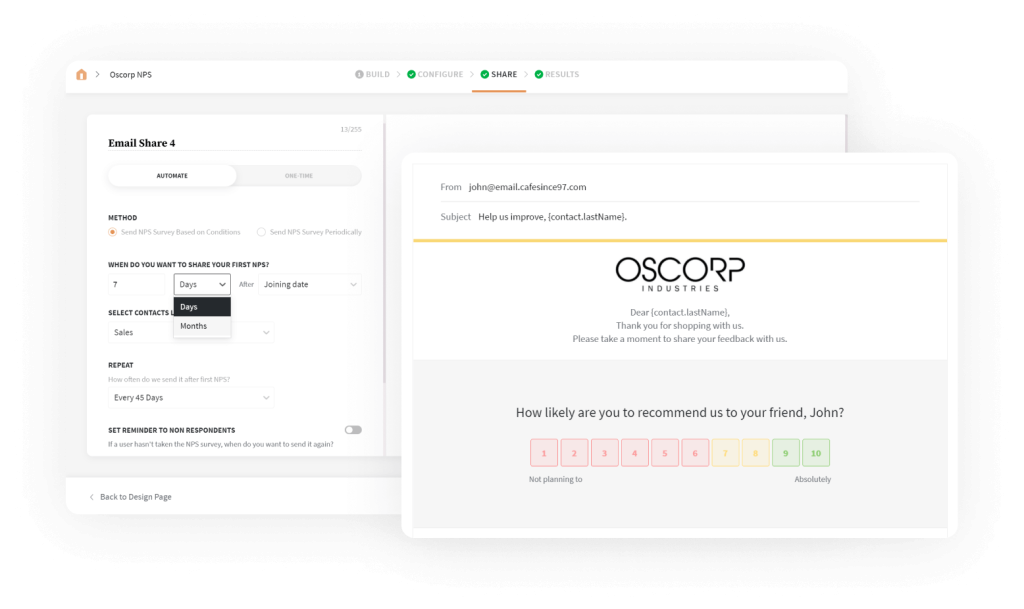
Schedule Automated NPS Surveys
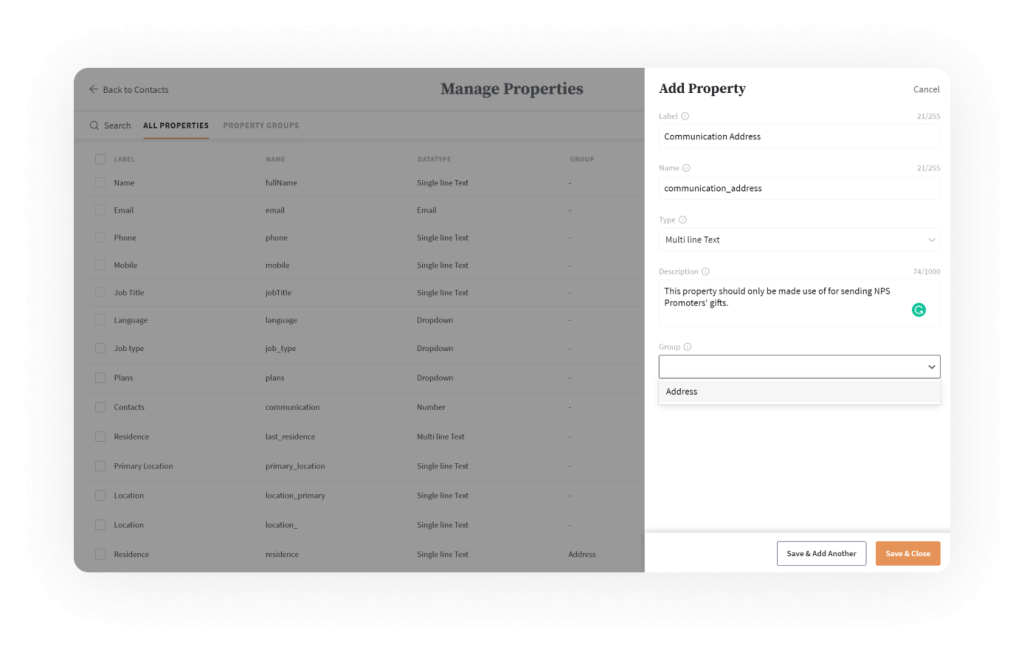
Easy Audience Management
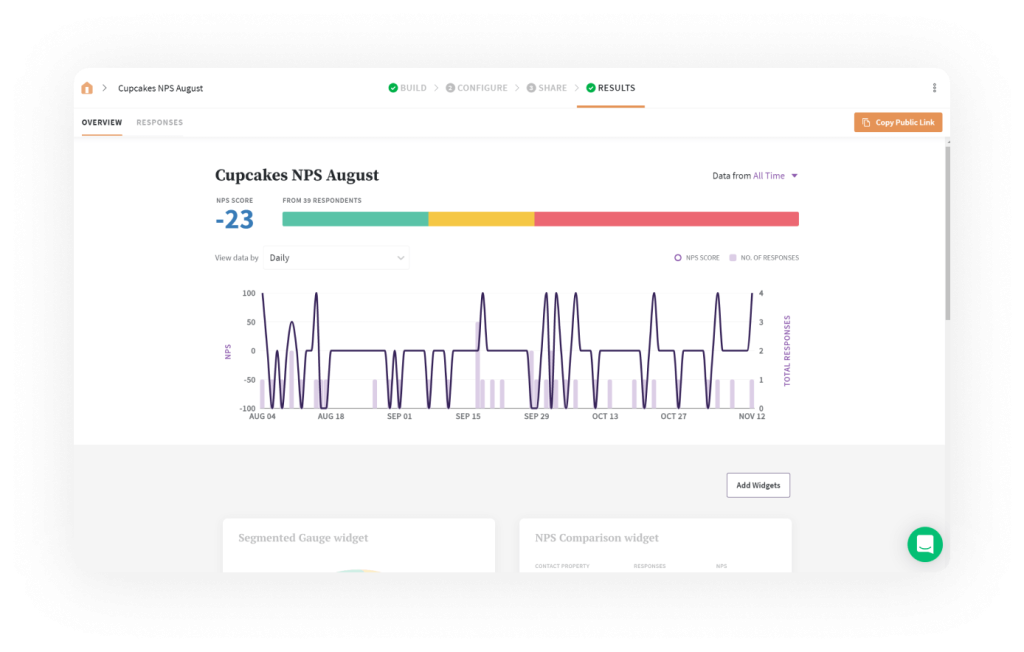
Analyze Data, Derive Insights
Integrate with other tools
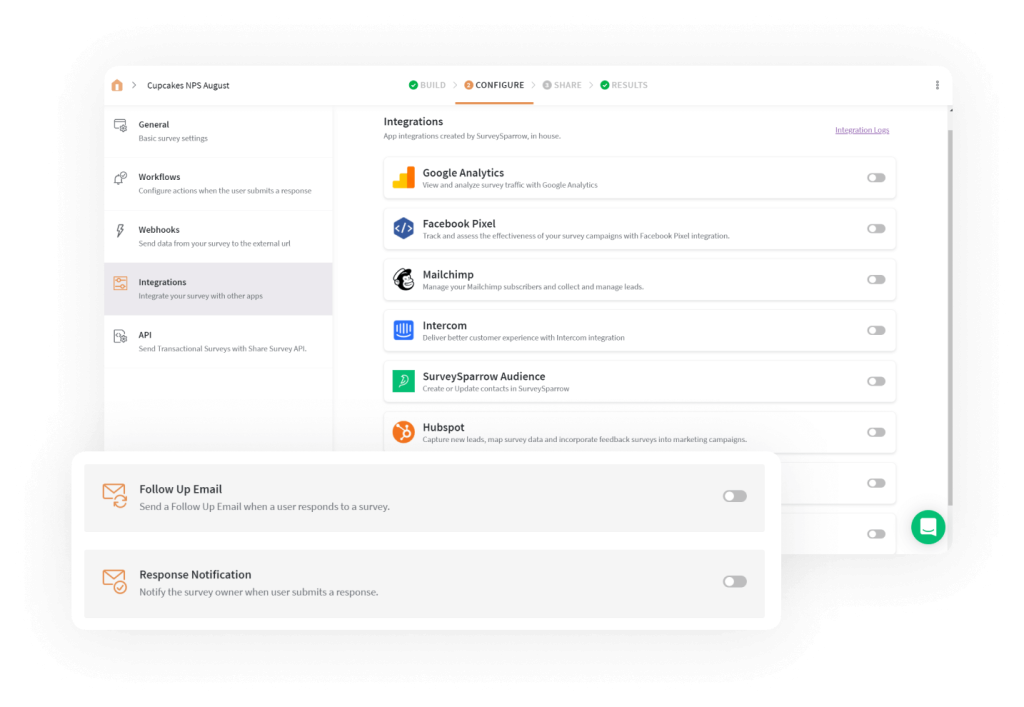
Connect the applications you use with your NPS platform using webhooks, APIs, workflows, or the popular Zapier Integration. For instance, when a ticket is closed in your helpdesk software, you can trigger an NPS survey from your NPS platform seeking customer satisfaction. For this, your NPS platform must support third-party integrations. Once a customer fills the NPS survey, the respective teams can be alerted to follow-up.
Role of Net Promoter Score in Industries
A few years ago, when a customer wanted to make a purchase, he/she would look at the tangible aspects, stepping into the shop, physically feeling the product or talking to a salesperson, face-to-face. But the scenario in today’s fast-paced world is super different. Today’s hi-tech customer simply goes online and does a thorough research about the product. They read reviews from existing customers, compare features/price from compare sites and also ask their friends/family for recommendations. It wouldn’t be too much to say that Sales teams today are rather expected to handle an over-informed prospects base.
With that said, it becomes mandatory for every industry to focus on their Online Reputation Management (ORM), if they want to stand a chance to be successful against their competitors. Each industry functions differently. Consequently, it has its own set of NPS values. Therefore, once your brand computes its net promoter score, benchmarking it against industry value helps to know where you stand.

SMALL BUSINESSES
Get real-time customer data, analyze trends, and reduce customer churn rates.

AGENCIES

HOSPITALITY & TRAVEL

HEALTHCARE
Care for your patients’ real needs and provide world-class healthcare service.

EDUCATION
Understand student satisfaction, staff engagement, and enrich the learning experience.

RETAIL

GOVERNMENT AGENCIES & CONTRACTORS

SOCIAL MEDIA

FINANCIAL SERVICES

POLITICS
Getting Started with NPS Platform